
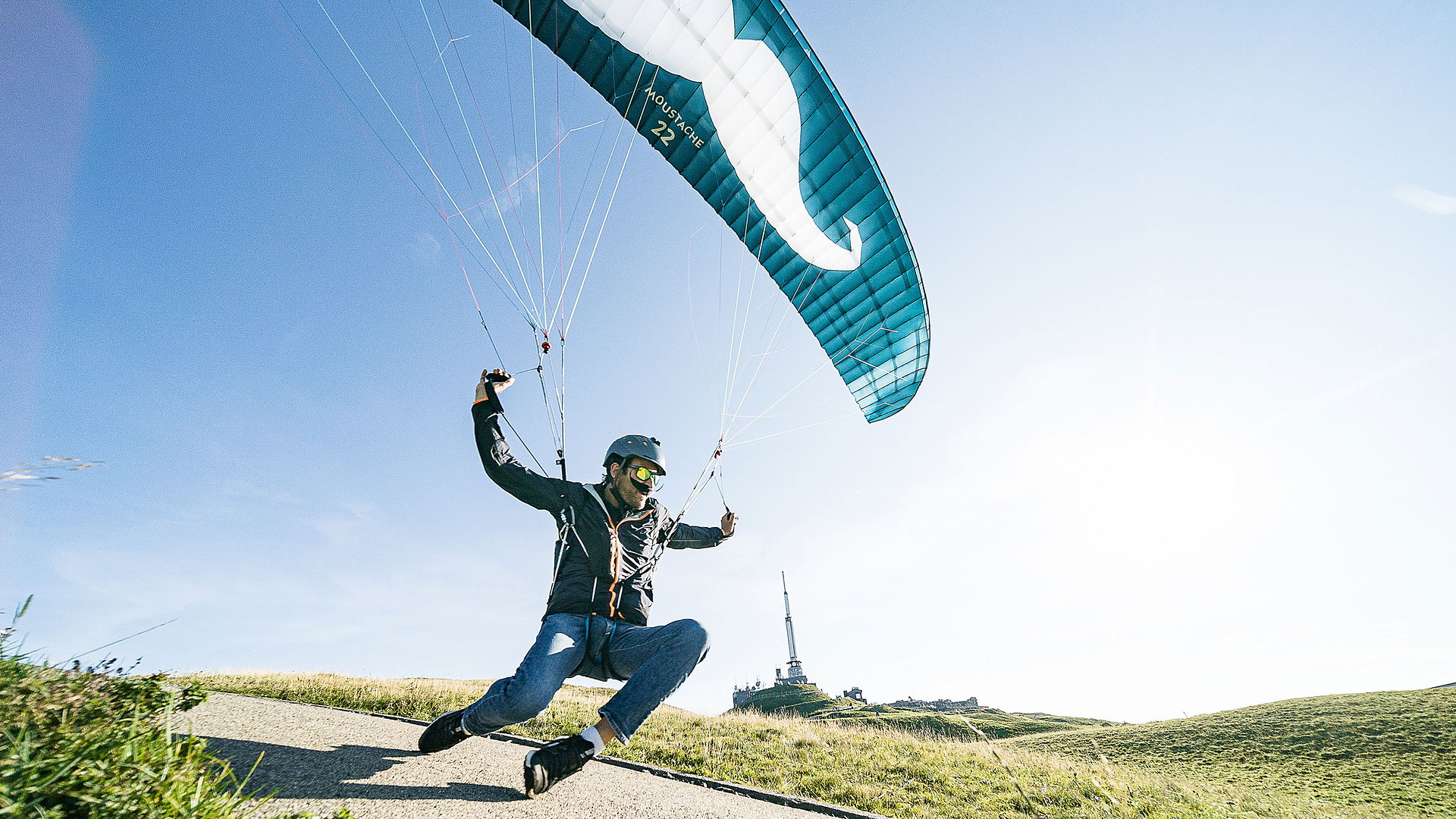
If you fly a paraglider and you have spent the past year watching videos of people skimming a dune on a tiny wing, wondering what on earth that is and whether it has anything to do with you, this article is for you. Parakite is the fastest-growing category in free flight, and also the worst explained.
Let me try to fix that.
What a parakite is
A parakite is a fabric wing, inflated by dynamic pressure like your paraglider, with a reflex profile and a control system that does not exist on a paraglider: kite-style risers that let the pilot change the wing’s angle of attack directly with their hands.
That last part is the whole definition. It is not the size, it is not the reflex, it is not that it flies fast. There are small miniwings, there are reflex paragliders and there are very fast wings that are not parakites. What makes a wing a parakite is where the angle-of-attack control lives.
The difference that changes everything: speed moves to your hands
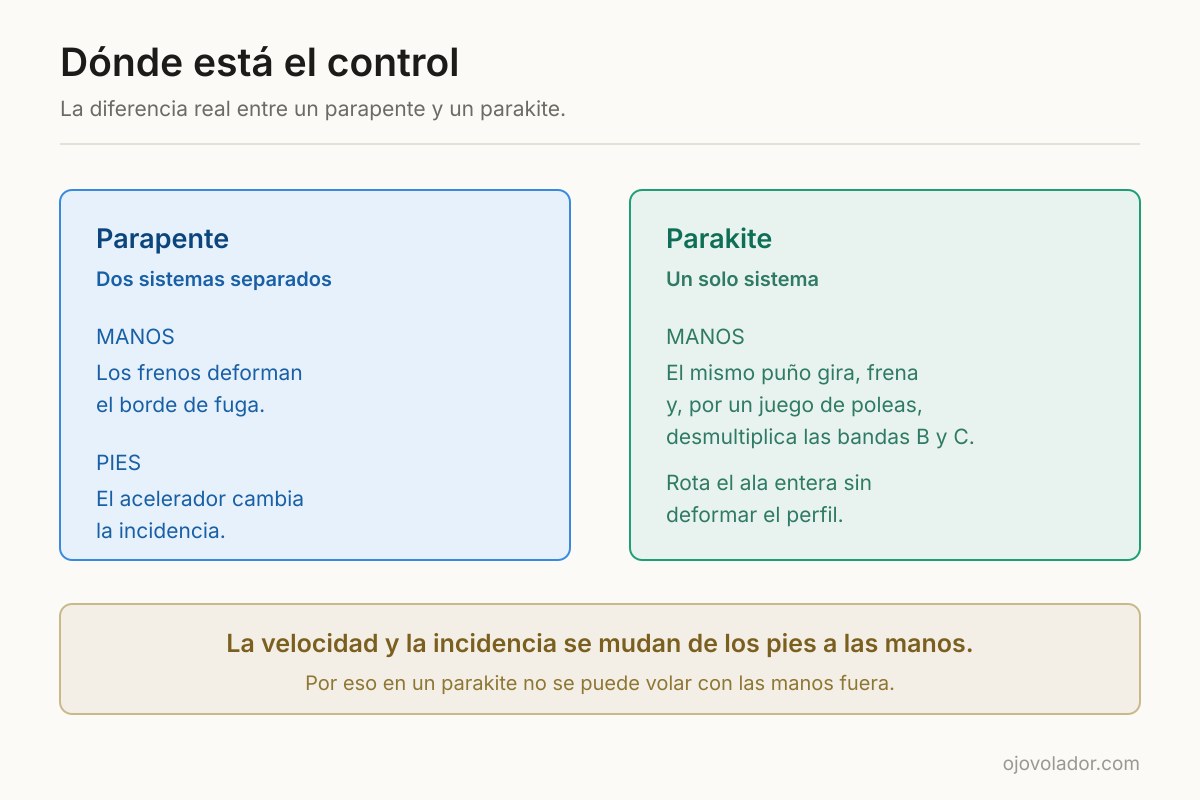
On your paraglider you have two separate systems. The brakes, which deform the trailing edge to turn and slow down. And the speed system, which you work with your feet and which pulls on the front risers to change the angle of attack and gain speed.
On a parakite those two systems are one, and it sits in your hands. The handle is connected by a set of pulleys to the B and C levels of the risers. When you pull, the system demultiplies that travel and moves the rear risers: you are not deforming the profile, you are rotating the whole wing. Angle of attack becomes something you govern continuously, like the throttle of a car.
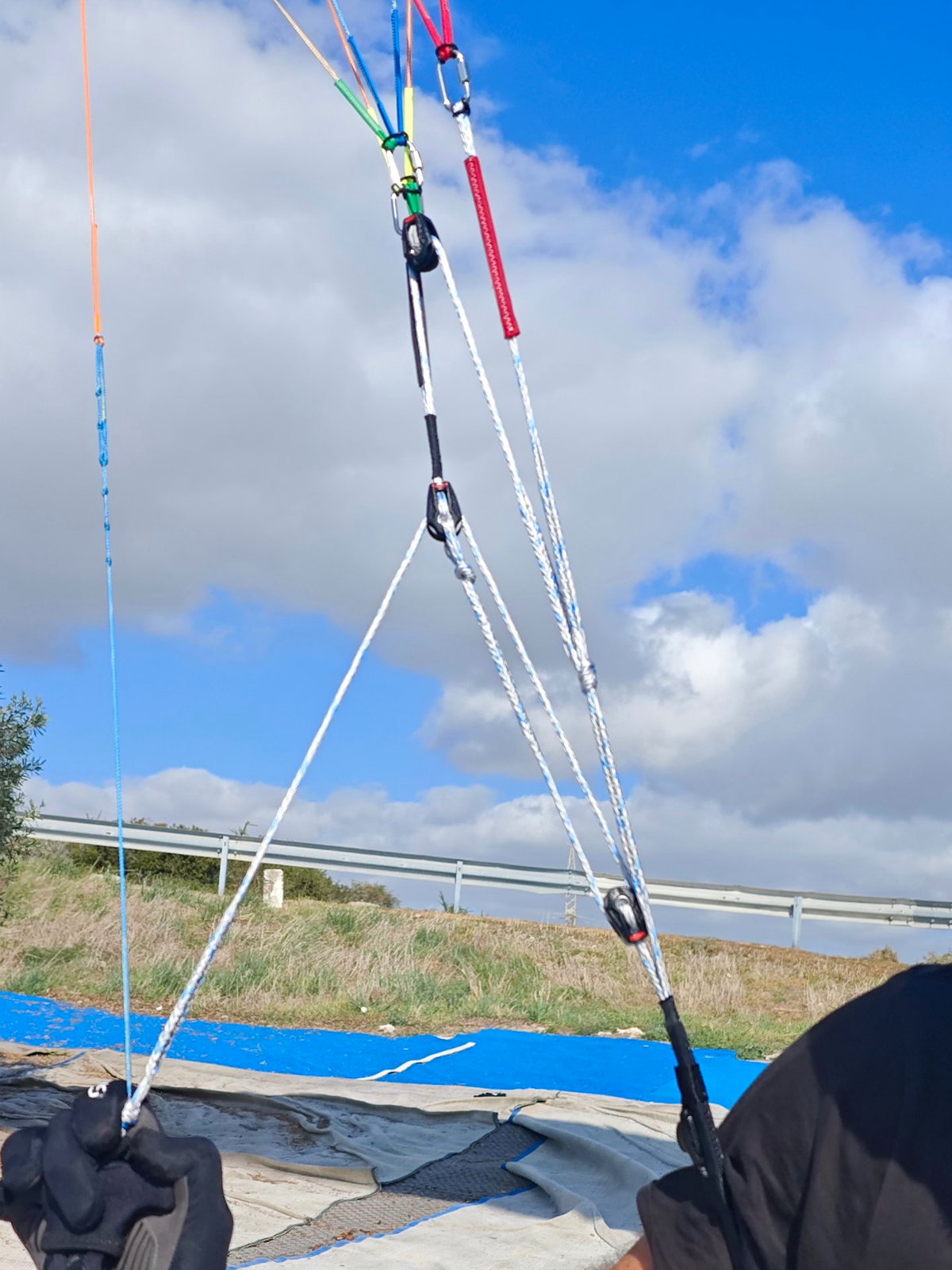
The first wing to do this was the Flare Moustache, in 2022, with what it called the Flare System. In that design the C level comes down a third of the brake’s travel and the B level a sixth. Each manufacturer then tunes its own ratios, the number of pulleys and the strength of the reflex, but the principle is the same across the category: Niviuk calls it PKS, Parakite System, and describes it in exactly the same terms. Neither the Level Wings Fuze nor the AirDesign Exta I am flying has a foot-operated speed system. The angle of attack is in your hands.
The Fuze was the first parakite I flew, and Level Wings the first brand to back this project. Those two wings are my way into the discipline, so everything I write here comes from them.
And this has consequences worth knowing before, not after
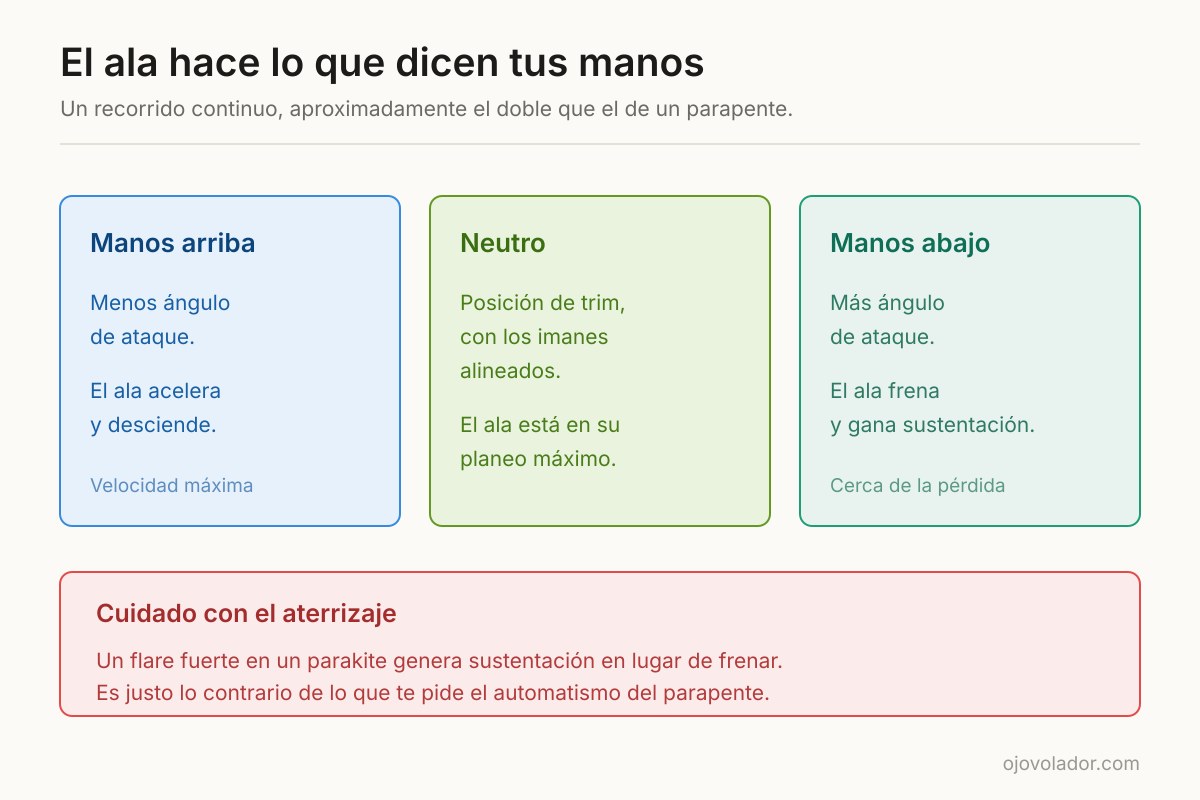
Control travel is roughly twice that of a paraglider with fixed trimmers. Hands up and the wing accelerates; hands down and it generates strong lift. Everything in between is range, and you are the one holding it.
You cannot fly with your hands off. No adjusting your harness, no fiddling with the camera, no letting go to scratch your nose. And you have to keep them still, because too much movement sets off porpoising.
But the one to really burn into your memory is the landing. A strong flare on a parakite generates lift instead of slowing you down. The movement you have been making automatically for thirty years does the opposite of what you expect here. If you come from paragliding, that reflex is your main enemy on day one.
A parakite cannot fly slowly either: its stall speed is higher, and it rises higher still the more loaded you are. But in my experience the wing warns you. You can feel perfectly well when you are reaching the limit, and recovering and putting it back into a good flying position is straightforward. In fact, looking for that point with plenty of height is an exercise I would recommend: the sooner you have it located, the less it will surprise you the day you get there by accident.
Antecedents: we had already tried this
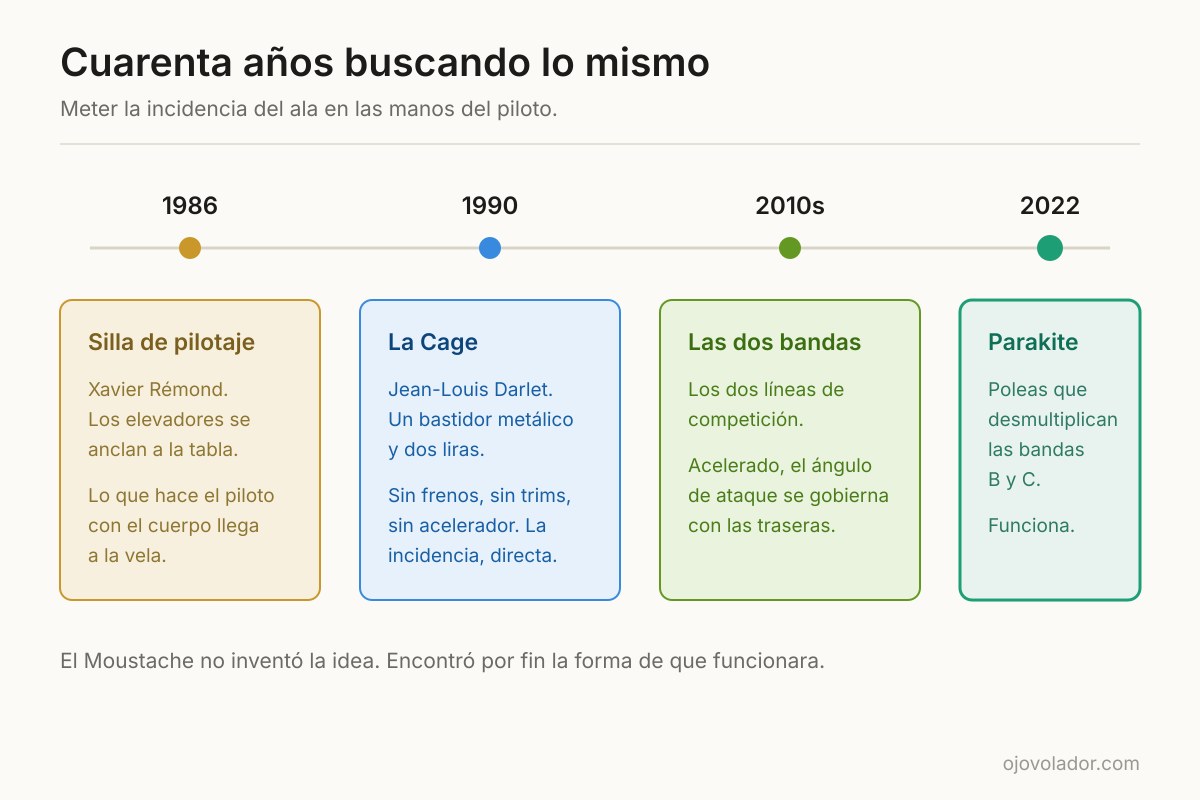
The parakite does not come out of nowhere. We have spent forty years circling the same idea: putting the wing’s angle of attack into the pilot’s hands.
The piloting seat (1986). French pilot Xavier Rémond created it with two goals: to raise the centre of gravity without shortening the lines, and to let the pilot receive the wing’s aerodynamic feedback directly. Unlike a conventional harness, the risers are independent and anchor to the seat board, so everything the pilot does with their body reaches the wing. It made its competition debut in 1987 on an Alnaïr 24, and Ali Gali won the French Championship with it. Between 1988 and 1992 it evolved from three attachment points to four, and Robbie Whittall went on to win a world title flying one. It was eventually shelved as wings became higher aspect, faster and less predictable in turbulence.
But back in 1992, in the pages of Vuelo Libre, José Sanmartín was already writing that for laminar, powerful sea breezes the piloting seat was irreplaceable, because it rested your arms and let you squeeze an extra edge of speed out of the wing when the wind picked up. Thirty-four years ago, someone had already described what a parakite is for.
La Cage (1990). Jean-Louis Darlet, a hang glider pilot and the inventor of the pif-paf, set out on Réunion to keep the paraglider’s wing and the hang glider’s handling. His invention has no brakes, no speed system and no trimmers: the lines anchor to a metal frame sitting between the lines and the pilot, who hangs from a single carabiner and works two lyre-shaped handles. Back dives and accelerates, forward climbs and slows. His pilots reported that in strong wind the spinnaker effect all but disappeared, precisely because the angle of attack was controlled directly.
Two-riser flying. The closest antecedent, and this one we have all had in our hands. When two-liner competition wings became the norm, a different way of flying came with them: accelerating and governing the angle of attack with the rear risers. That is rudimentary parakiting. Anyone who has crossed a valley on full bar working the Cs knows exactly what we are talking about, and many of us had spent years fantasising about what would end up being the parakite.
Three attempts in forty years, with different technologies and different luck, chasing the same thing. The Moustache did not invent the idea: it finally found a way to make it work.
Sources: the articles on the piloting seat by José Sanmartín, Carlos Izquierdo and Armand Rubiella in Vuelo Libre / Parapente no. 4, and FFVL and AsPiC documentation on La Cage.
And a personal prediction, in case anyone wants to hold me to it: one way or another, before long we will see this control system built into paragliders. Perhaps first on competition wings, where we have been flying on the rear risers for years and where the idea would fit almost without explanation. We shall see.
A parakite is not a miniwing
This is the most common confusion, and it is understandable: from the ground they look very similar. But a miniwing is a small paraglider flown at higher wing loading, and it keeps the paraglider’s handling logic. Brakes that deform the trailing edge, speed system at your feet, hands off if you like. What changes is the size and the speed, not the system.
A parakite changes the system. And that has one very concrete practical consequence when you are choosing: in the same conditions you can fly a parakite around 2 m² bigger than a miniwing. That extra area translates into more margin, more time in the air and less speed over the ground.
The same goes for the speed wing. A speed wing is built to come down fast and close to the terrain. A parakite can do that, but its natural ground is elsewhere.
And having said that, the vocabulary is about to get complicated. A parakite is not a miniwing, but small parakites already exist that are, to all intents and purposes, miniparakites: reduced sizes with the full control system, filling exactly the gap miniwings used to fill. So do not fight the labels too hard and always look at the riser system, which is what really tells you what you will have in your hands.
Reflex: what it gives you and what it charges you
Every parakite has a reflex profile, to a greater or lesser degree. Reflex self-balances the angle of attack, which allows more speed and keeps stability at low angles. It is what lets a parakite hold its ground in wind that would leave a paraglider parked above your head.
In exchange, strong reflex damps the information reaching you from the air, reduces glide efficiency and produces more violent collapses when they do come, because they happen under more pressure, at more speed and at more extreme angles.
How much reflex a wing carries is the most important decision of character a designer makes, and it defines how the wing feels in the air. I go into it at length in the AirDesign Exta test log, but the short version is that there is no correct point: there is the one you like and the one that suits you depending on the day.
What a parakite is for, and what it is not
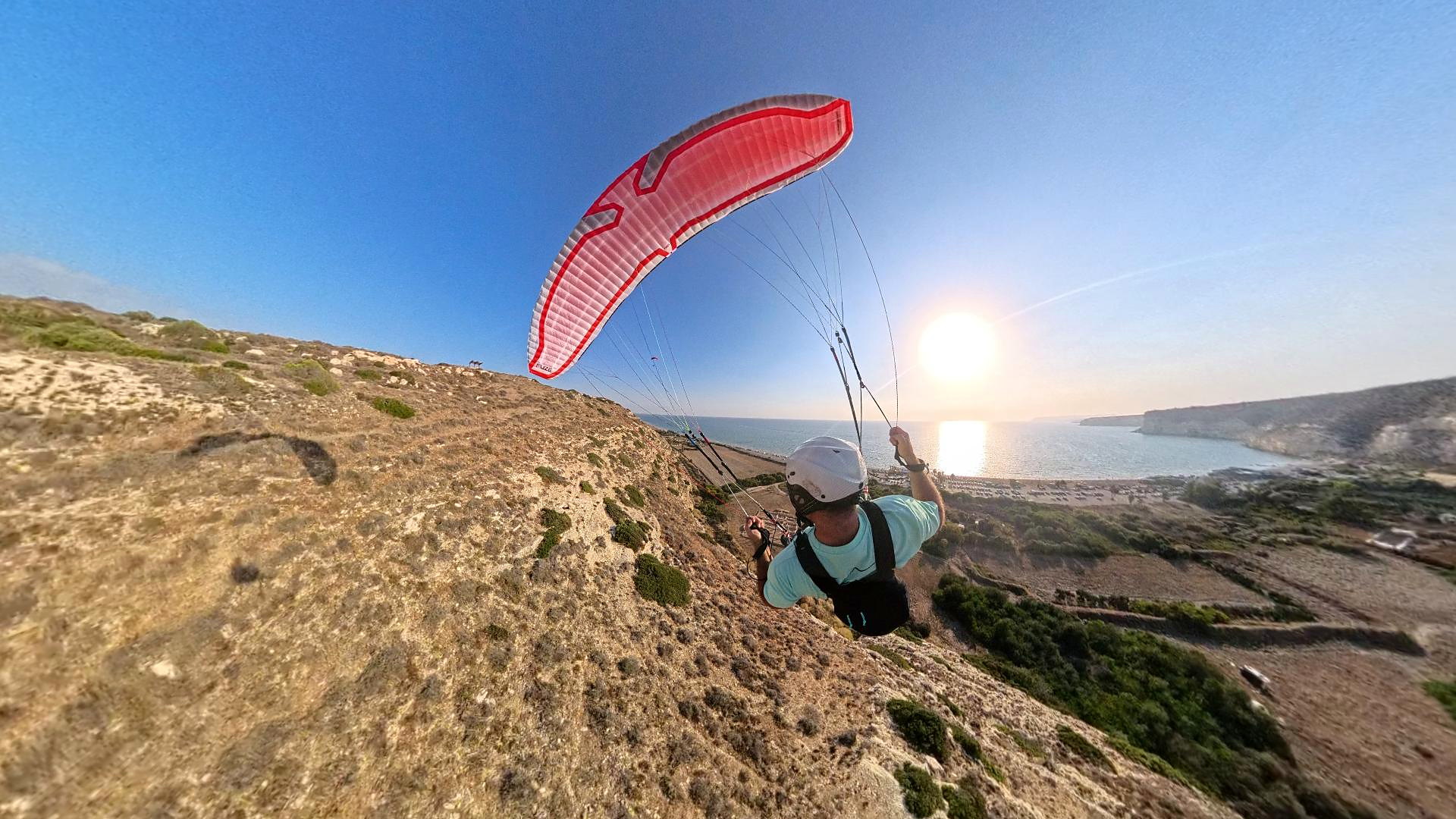
Where a parakite shines is soaring in strong wind and close to the ground: coast, dunes, sea cliffs. Also in fast-style dynamic flying, in proximity and, with specific wings, on paramotor. It flies in conditions where your paraglider would sit above your head going nowhere.
Where it does not shine is in thermals. Working the cores is hard because tight turns are difficult, and although there are manufacturers pushing the category towards the mountains and thermal flying, as things stand today that is not the ground where a parakite will give you its best.
And it has a ceiling. In very strong coastal wind, above 40-50 km/h, turbulence appears and abrasive sand becomes a real problem for the wing. The general recommendation going around is not to go beyond 30-35 km/h unless you are a very experienced pilot. I operate above that figure and explain why in my article on inflating and wind limits, but a conservative recommendation exists for a reason, and the place to start is clearly below it.
Certification: what the label does not tell you
This needs to be very clear, because it is where most people get confused.
The EN 926 standard has two parts. 926-1 is the load and structural strength testing: it checks that the wing holds together. 926-2 is the flight testing: the manoeuvre protocol that produces the EN A, B, C and D ratings you know.
Parakites advertised as EN 926-1 certified have passed the first one. There is no in-flight behaviour rating for parakites. None is EN-A or EN-B, and that is unlikely to change soon, because the protocol’s manoeuvres simply cannot be flown with kite risers.
Put another way: the number on the label tells you the wing will not break. It does not tell you how it will behave. That comes from your judgement, your training and the conditions of the day.
This has practical effects. In the United Kingdom, for example, pilots with no previous flying experience are not allowed on a parakite, precisely because of that missing rating. And teaching is being formalised: since October 2026 there are specific parakite courses of six to eight days with an internationally recognised qualification.
The varieties, from a bird’s eye view
The category was born looking at the coast, but in four years it has fanned out. Broadly, this is what you will find today, and each entry deserves an article of its own, which we will be writing.
- Strong-wind soaring. The original ground. Very strong wind on a cliff or a dune, where what you want is a solid parakite and not too big, because you are there to hold on and be in charge, not to get performance.
- Laminar coastal parakiting. A different game, and for me the most beautiful one. Clean coastlines, moderate wind and higher-aspect wings flying just above the beach. Here you do fly higher-performance wings and what you are after is the line, not survival.
- Mountain and hike and fly. The most recent bet: ultralight wings that fit in a small rucksack, built for active air and for coming down playing with the terrain. This is where the Exta sits.
- Speedfly and speedride. The most spectacular face of all this.
- Paramotor. Specific wings for proximity under power, where having angle-of-attack control in your hands completely changes the way you fly low.
- Learning sizes. The large areas in each range, more stable and more accessible, built for getting into the discipline.
Speedfly and speedride are worth pausing on, because they are responsible for the image almost all of us have of the parakite. Brutal descents between canyons, barrel rolls, a flat-out low pass and a radical landing skimming the water. Those are the images that circulate most, and for a while they led me to the wrong conclusion that the parakite was something very radical and not much else. Then I met people doing recreational ridge soaring on a parakite, calmly, for hours, and I realised I had mistaken the tip of the iceberg for the iceberg.
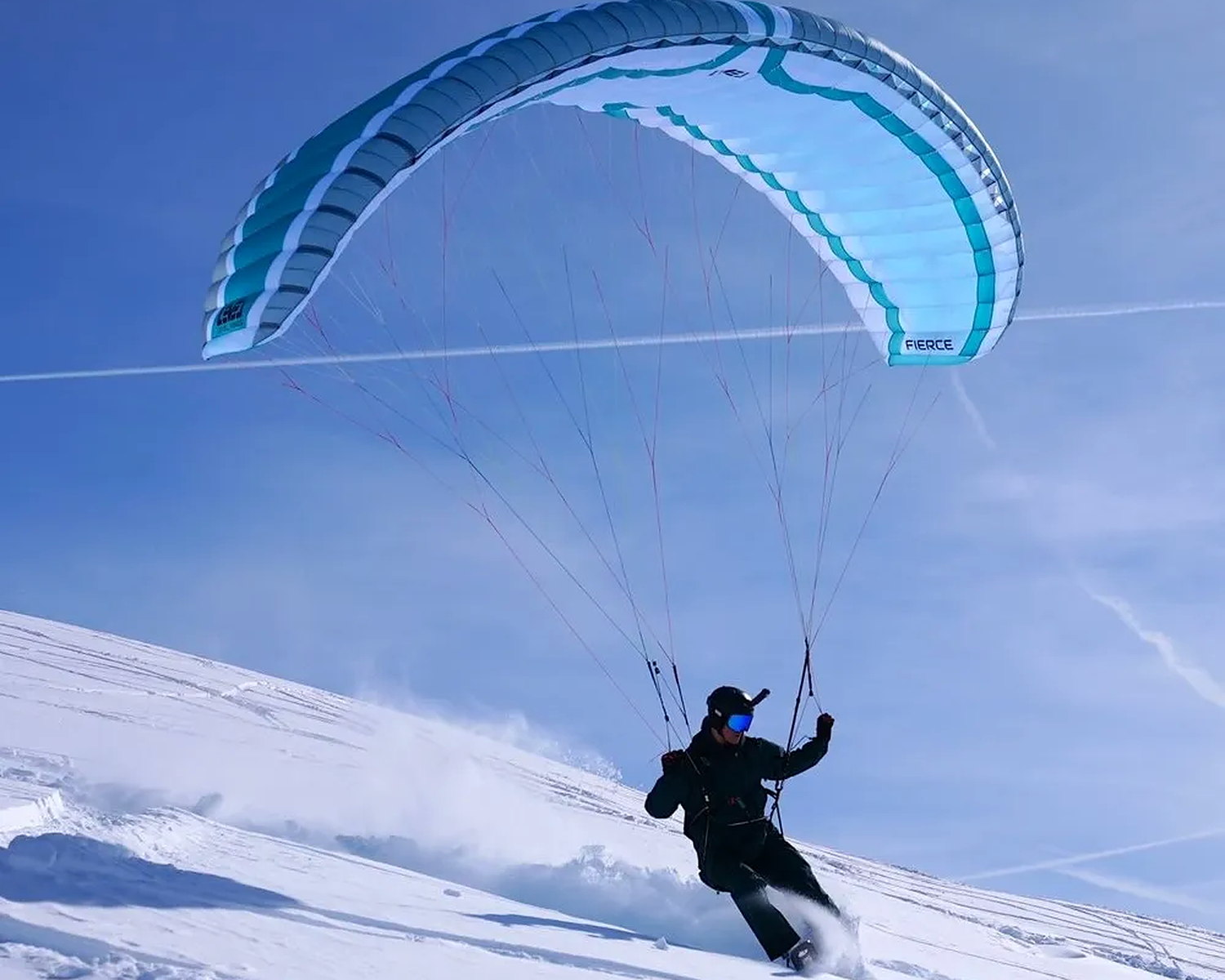
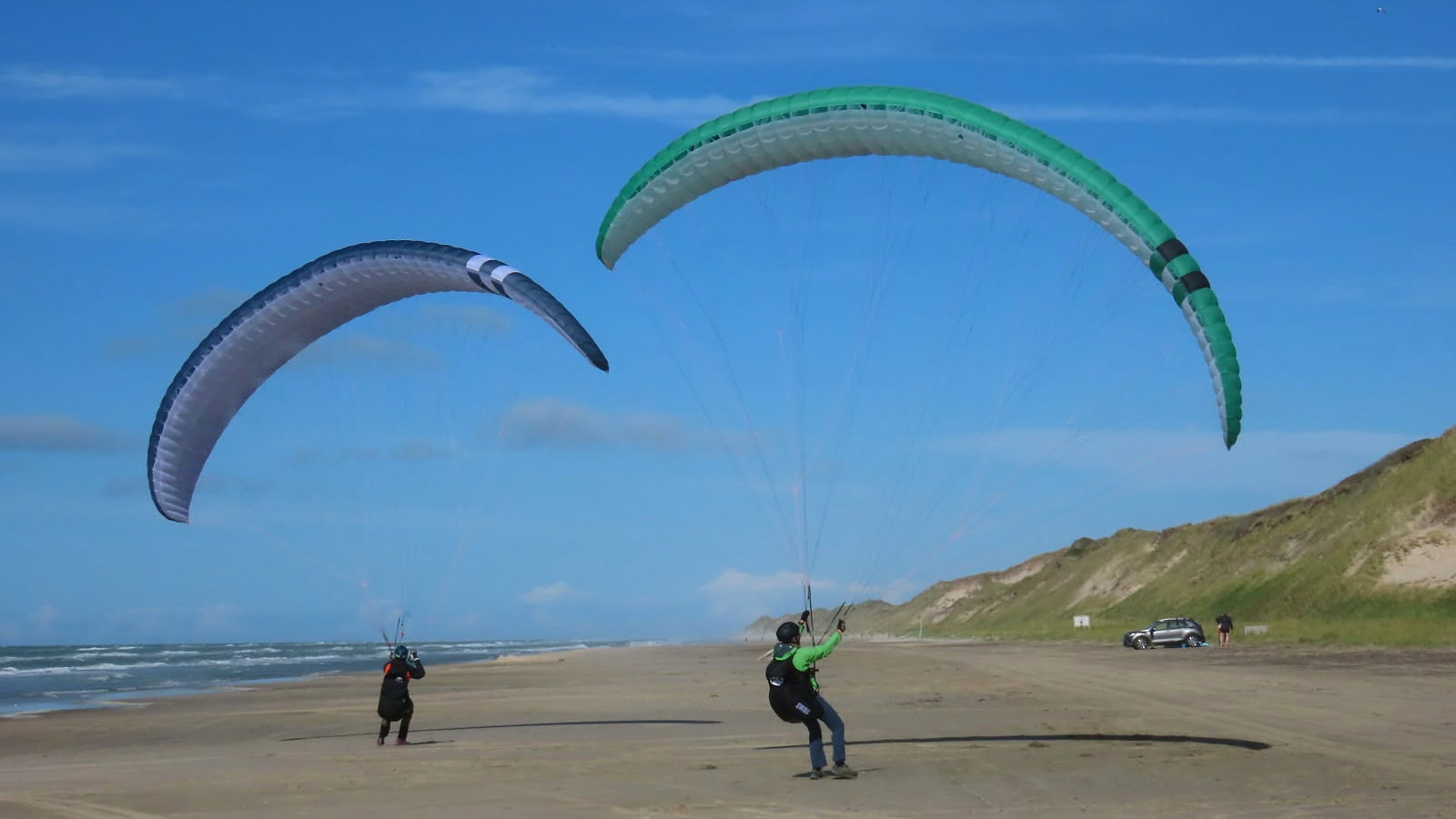
And it is worth knowing that size is not only a question of weight. The big ones are easier and perform better in light wind; the small ones fly closer to the ground, have more acceleration range and are faster. A low aspect ratio also makes ground handling a great deal easier.
How you learn
The short answer: on the ground.
The skill you really need in order to fly a parakite is ground handling. You have to be able to work the wing above your head with ease before you start thinking about taking off. Then come the little hops and the short, low flights, where the two classic mistakes get corrected: holding your hands too high, which means you fly fast and do not climb, and moving your hands too much, which is what sets off porpoising.
Three practical recommendations that come up again and again among the people who teach this. Use a split-leg harness, because seat-board harnesses give too much roll authority on the small sizes. Wear back protection, because you are going to fly close to the ground. And untangle absolutely everything — lines, risers and handles — before you inflate.
And one warning that seems to me the most important of all: reflex transmits a feeling of solidity that invites complacency. The wing holds on so well that it is easy to believe it always will. When it finally does collapse, it does so more violently than a paraglider, with more pressure and more speed. That combination of a feeling of safety and hard consequences is exactly the accident profile to avoid.
This is explanation and personal experience, and it does not replace training. In a discipline with no flight certification, a qualified instructor is not a luxury.
Who makes parakites
In 2022 there was one brand. Today the list changes every month, and the conclusion at the 2026 Coupe Icare was that every brand either has a parakite or is developing one.
The category was opened by Flare in 2022 and it still keeps the widest range, with the Moustache² as the soaring benchmark, the Scout for progression, the high-aspect Bandit, the Line for speedfly and the Prop for paramotor.
Level Wings
I am starting here because it is the story that best explains what is happening. Level Wings is a small company, very focused on miniwings and speedflying, which has folded parakites into its range in the most natural way imaginable: they are the next step on from what it was already doing.
The Fuze is its soaring proposal, and the brand itself describes it as a soaring machine. It has ABC kite risers with dive blockers, Porcher Skytex construction and a size range they have kept widening as the wing caught on, adding a 10 and a 22.5. The Fierce is the other extreme: a speed parakite built so you do not have to choose between speedriding and speedflying, in sizes from 9 to 16. And in 2026 they made the jump to paragliders with the Falcon, a lightweight high-end EN-B on 2.5 lines.
AirDesign
The Exta takes the concept to the mountains. It is the first lightweight parakite on the market, from 1.85 kg in size 12, built for high soaring, thermals and hike and fly rather than for the coast. I cover it in detail in its test log.
The small brands
And here is one of the healthiest things about this discipline. Because there is no flight certification, there is also none of the enormous cost of passing one. That has opened the door to small manufacturers who can come in with very personal designs without ruining themselves in the attempt: Little Cloud, Flow, Dune Rider, Vril Wings, MK-Flightsystems, Swing, BGD and APCO, each with its own character and its own way of understanding a wing. This is one of those stages where the catalogue is written by the artisans before the corporations get there, and it usually does not last long. Let us enjoy it.
And the big ones
Niviuk has come in with the Jester, its first parakite, with a system of its own it calls PKS, Parakite System: five sizes from 14 to 24, 53 cells, 5.50 flat aspect ratio and a 115 kg maximum all-up weight. And Ozone, a world reference, presented the Vapor in September 2026, its first production parakite, pitched as a sport-class wing.
When the big brands come in, a category stops being a fad.
We keep each manufacturer’s entry up to date in the Ojovolador parakite manufacturers directory, with their models, their sizes and their official links. If a brand is missing, write to us and we will add it.
The Parakite Odyssey
I have been flying since 1993. I have competed, I have flown thousands of tandems, I have tested hundreds of paragliders. And in parakite I am a beginner.
That is exactly the reason for this series. I am learning a new discipline with thirty years of flying behind me, and I am going to tell it as it happens: what I understand, what I struggle with, what surprises me and what I treat with respect. Without waiting to become an expert, because by the time I am one I will have forgotten what was confusing.
We will take it in parts. The test logs of the wings I fly, the concepts you need to understand — sizes, wind, cobra launching, handling — and the stages for progressing from a paraglider. All of that lives in the Parakite section.
If you are thinking of getting into it, come with me. We are going to learn together.