When paragliding, especially cross-country, we are always exposed to the unexpected. Knowing how to improvise an emergency landing is crucial, and the best decision is not always the most obvious one. Your safety must always come first.
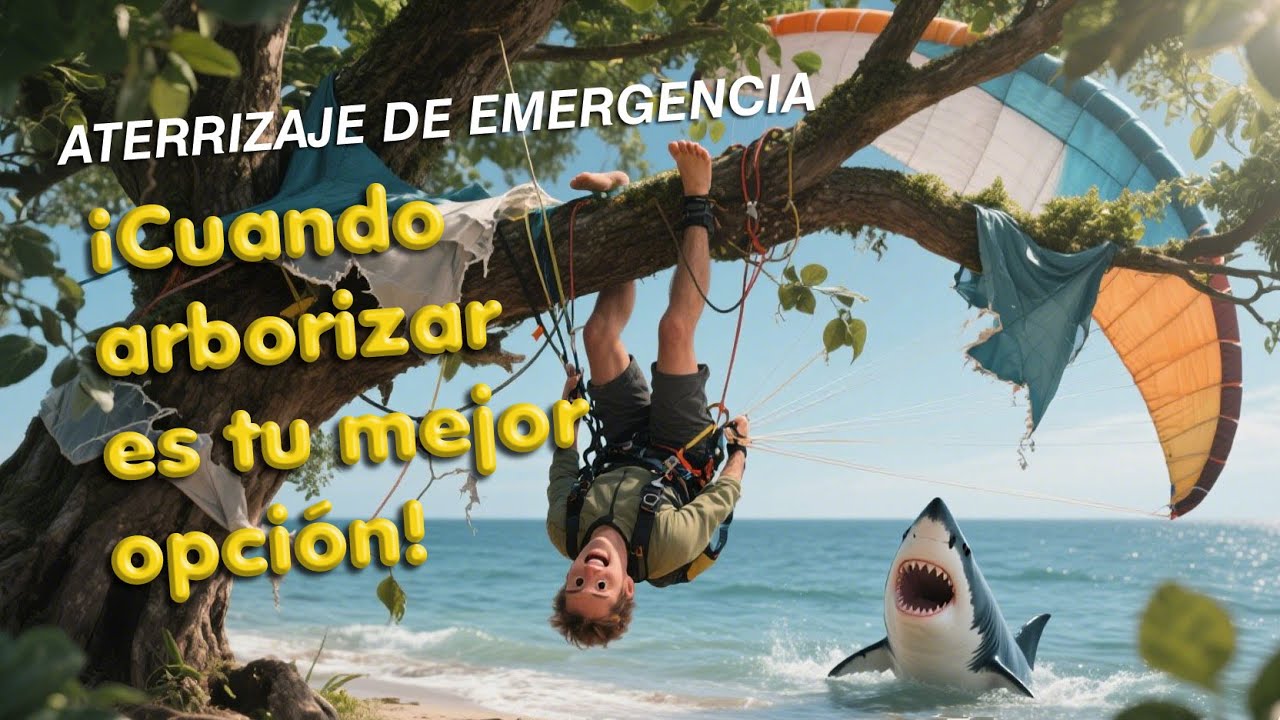
Many of us, especially as beginners or when flying new equipment, tend to protect our gear above our physical integrity. But looking after the wing or the harness can never come before protecting your body. Knee or spine injuries from forcing a landing can have serious, lasting consequences. Equipment can be replaced; your body cannot. That is why it is essential to change your mindset: it is better to damage your gear than to hurt yourself. In this context, a tree landing is not always bad news. In fact, in some situations it can be the best way to walk away unharmed.
My tree-landing experiences
Over the years I have had several experiences that taught me valuable lessons about how a tree landing can save you.
My first was in Trujillo, Venezuela, when I was still very much a beginner. I was flying a borrowed paraglider and had to land on a football pitch surrounded by palm trees. I misjudged it, overshot the pitch and ended up hanging from a palm tree. The wing was damaged and I had to pay for the repairs, but I came out without injury.
In Japan, in 1998, I was working with Aerotact and flying a size L paraglider. While practising an acro sequence over a forest, I got tangled in the wing after a manoeuvre went wrong. I lost height quickly and threw my reserve, which had trouble opening. I finally landed in the trees without serious damage. Had I tried that sequence over other terrain, the outcome would have been different. Choosing to do it over the forest probably saved my life.
Another intense experience was at my first Spanish Championship, in La Seu d’Urgell. We were flying in strong wind and, as I approached a turnpoint in Organyà, I was blown backwards with nothing I could do. I chose to fly downwind at 70 km/h straight towards a group of pine trees. I got caught in one, surrounded by sharp branches that could have caused serious injuries. Although it was dangerous, the impact was smaller thanks to the trees.
These situations taught me that, although a tree landing can damage your equipment, it is often a small price to pay to protect yourself.
Anticipating problems
A key lesson: the best problems are the ones you avoid. In Organyà, I did not anticipate the risk of the wind. As a beginner, I did not properly assess the location of the turnpoint or the conditions. Had I done so, I could have chosen a safer route before entering a critical area.
Anticipating means continuously assessing the wind, the terrain and obstacles (such as power lines), and always having landing options in mind. It is part of active planning in cross-country flying, not a reaction to an emergency.
When flying, we look for routes and thermals, but we must also identify possible landing fields along the way. Anticipation does not guarantee avoiding every problem, but it drastically reduces risky situations.
Practising accuracy can help
The ability to land accurately is vital. It lets you improvise landings in small spaces or in difficult conditions. Improving this skill widens the options available to you during a flight.
However, even with good technique, the unexpected can happen: hidden cables, wind changes, misjudgements or loss of lift at low altitude. In those cases, attempting an accuracy landing can become riskier than steering the paraglider towards a group of trees.
That is why I have mentally accepted that a tree landing is a valid option. I see it as part of my safety strategy. It is not about giving up, but about consciously choosing what best protects my body.
Practising accuracy does not eliminate risk, but it helps avoid many emergency situations. A tree landing, when necessary, becomes one more tool in the repertoire of safe decisions.
Tips for an emergency tree landing
Based on these experiences and on safety principles, here are some practical tips:
- Prioritise your body over your equipment: always. A torn wing can be replaced. A damaged knee or vertebra can affect you for life.
- Accept a tree landing as a valid option: don’t see it as a failure. If a landing gets complicated, trees can slow your fall and prevent injury. It may be the best alternative.
- Practise accuracy: it increases your safe landing options and reduces the need to improvise in difficult conditions.
- Always anticipate: constantly assess your surroundings, the wind and obstacles. Having a plan B and C is part of responsible flying.
- If there are no good options, choose the least bad one: you won’t always find the perfect spot. Sometimes a wooded area is better than risking a more dangerous landing.
- Land into the wind if you can: it reduces your ground speed. In trees, it can also help cushion the impact.
- Make a good final approach: even in an emergency, try to keep enough control to orient the wing and your body in the best possible way.
In short, cross-country flying means taking risks, but also being ready to manage them. If you face a critical situation where the conventional options expose you to serious harm, remember: a tree landing can save your life. It is not a defeat; it is a smart decision. Look after your body above your gear. Fly safe.