
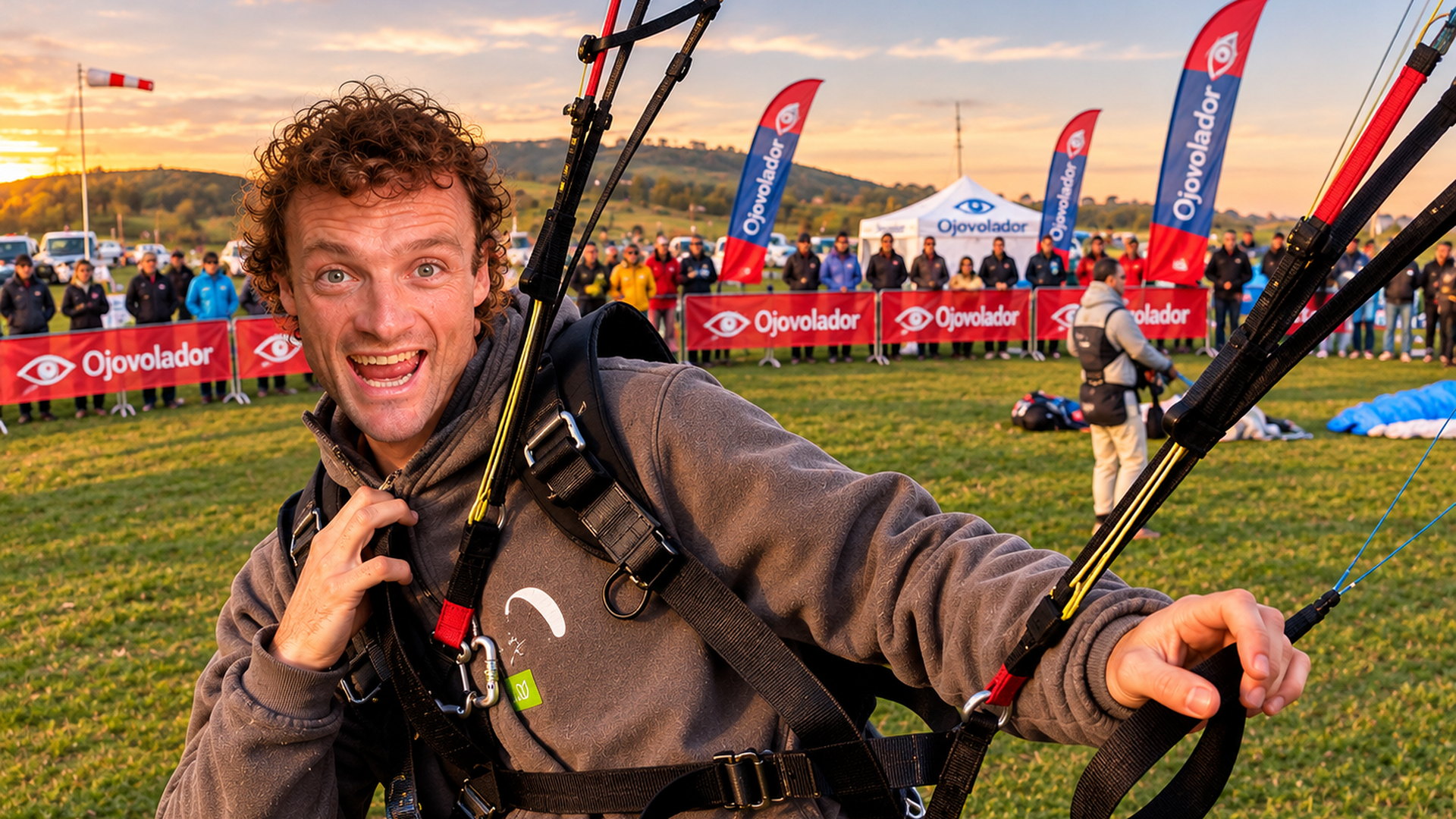
We are rescuing one of the most watched videos in the Ojovolador archive. Raúl Rodríguez explains how he inflates the wing and a ground stall exercise that, years later, is still completely valid.
Raúl is our good friend, an acro legend and a founding teammate of the SAT Team. He created most of the acro manoeuvres, starting with the SAT, the move that is the basis of almost everything that came after it: asymmetric SAT, tumbling, infinity. The video is old, but every reference he gives still holds today.
Las Candelas: a paramotor festival and a strong breeze
That day we were at the Las Candelas festival, the benchmark paramotor festival in Spain. But it was a great excuse to start playing on the ground, making the most of a strong breeze. The SAT philosophy always invites you to play, whether in the air or on the ground. And although our lives have taken different paths, every time we get together we are basically the same: having fun with what we love, paragliding.
The toy: a 14 m² Matrix
Raúl introduces it as «a little toy». It is the Matrix, from his own brand, a wing that is simple to design and simple to handle, made for mountain flying, for coming down fast or for acro. That day he was going to fly it with a paramotor, having tried it before in Granada. It needs wind to launch, like any other.
The inflation technique: hands where they are going to stay
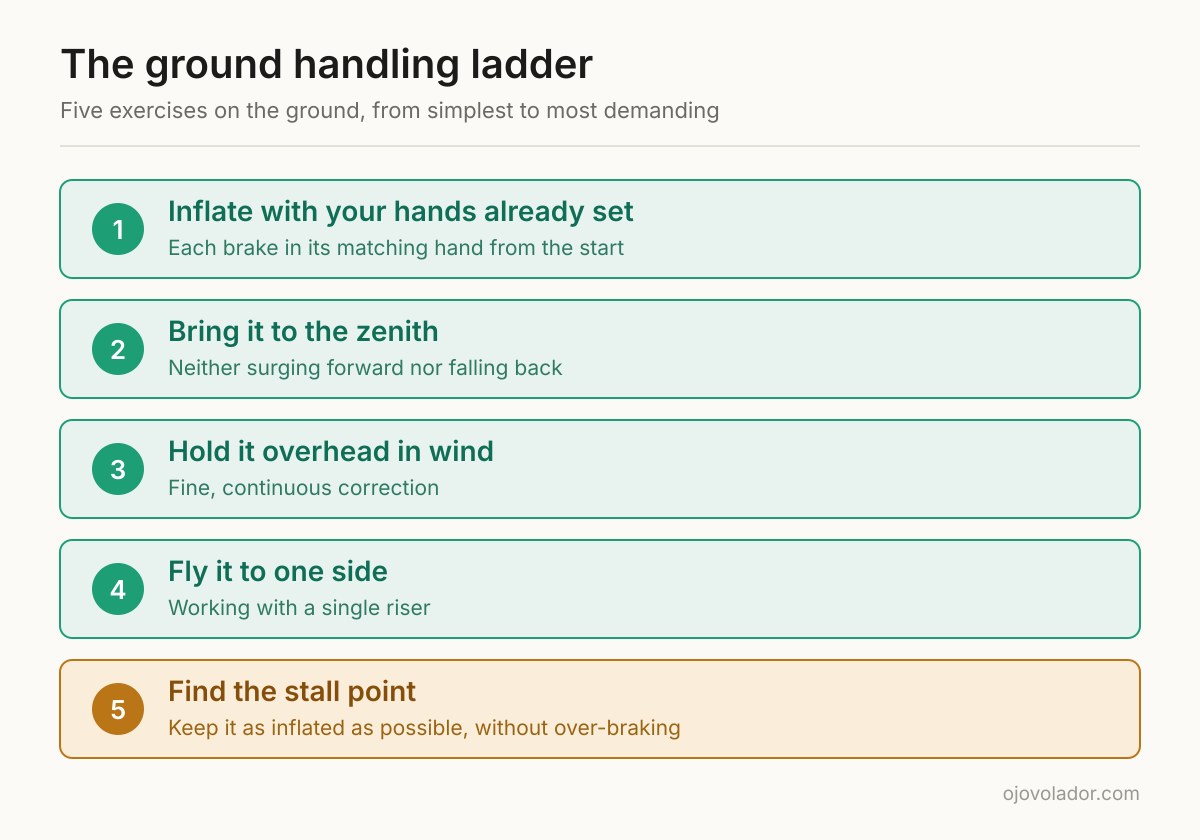
Here is the tip that justifies the video. For Raúl, the safest technique is to grab the brakes from the start with the hands that will hold them once the wing is up, so you never have to let go and grab again. You pull the risers with the brakes already set, each handle in its matching hand. The advantage is obvious: if a gust takes you flying, you are already in the piloting position.
Put like that it sounds minor, but it is what separates a clean launch from one with a hand swap at the wrong moment, right as the wing is coming up.
Keeping it overhead: neither forward nor back
With the wing overhead, the job is to hold it in place: not letting it surge forward and not letting it fall. That control is exactly the one you need for everything else afterwards.
Finding the stall point, on the ground
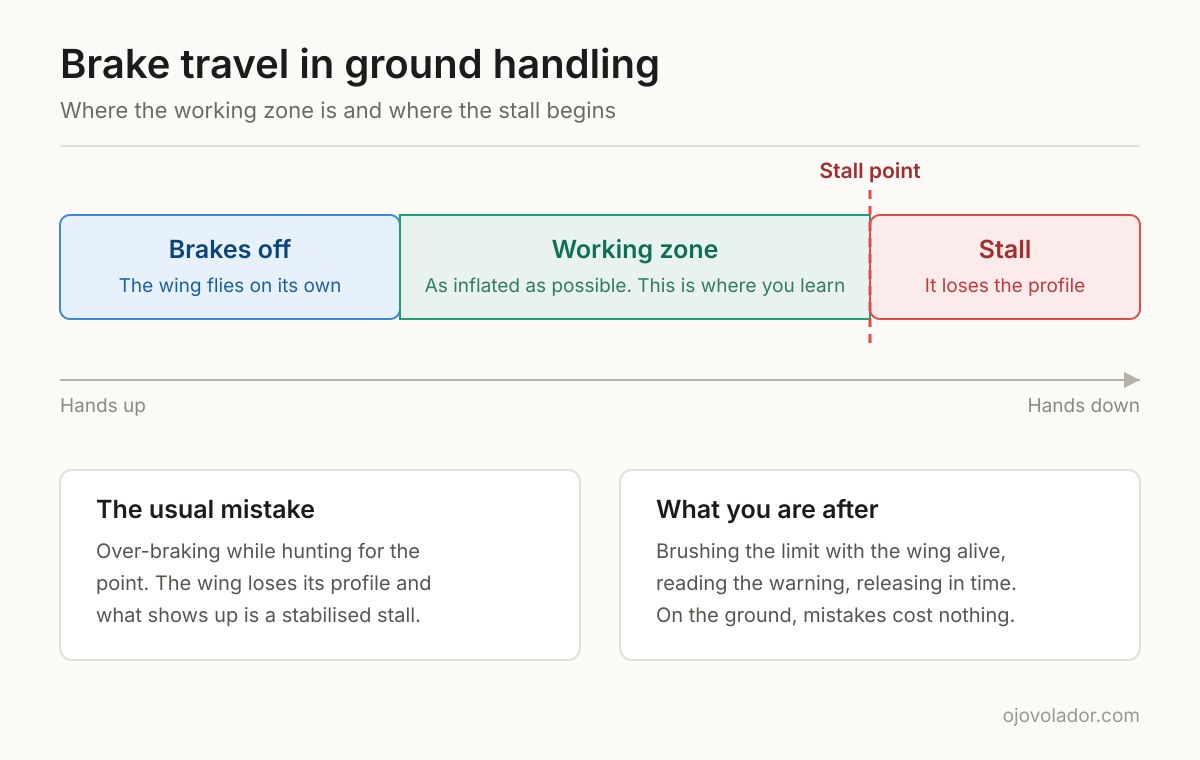
From there Raúl moves on to the exercise: finding the feel of the stall with the wing on the ground. The key, he says, is keeping it as inflated as possible, without braking too much, because then it loses the profile and what shows up is already a stabilised stall.
His advice is direct: if you want to learn to do stalls properly, practise them on the ground first. And even before that, another interesting exercise is keeping the wing flying to one side, working with a single riser.
The dune trick
The last exercise has a very practical use: flipping the wing over and bringing it back up. On the dune it is not optional. The wing fills with sand while you play and you have to empty it, rolling it backwards so it all falls out.
Ground handling: the best time you will ever invest
If there is one single thing a pilot can do to progress fast, it is to put in hours of ground handling. There is no shortcut that replaces it and no equipment that makes up for it. The pilot who flies best is usually not the one with the most airtime, but the one who best understands what their wing is doing, and that is learned with your feet on the ground.
The reason is simple: the wing behaves the same one metre up as it does a thousand metres up, but down there mistakes cost nothing. In one afternoon of ground handling you do dozens of inflations; on a flying day you launch two or three times. That difference in repetitions is what turns a correction into a reflex, until one day you stop thinking about what your hands are doing.
And what you train on the ground is exactly what fails on launch: setting your hands before you pull, bringing the wing to the zenith without overshooting, holding it there in wind, controlling it when it goes to one side, and knowing what it does just before it stalls. All of that, when the difficult day comes, is already learned.
You do not need a special site or particular conditions. A field, some breeze and the will to play. It is free, it is safe and it is, by a long way, the best time you can give your paraglider.
A personal observation, confirmed over the years: there is one trait that has always defined acro pilots and, in general, pilots with good hands, and it is a passion for ground handling. For an acro pilot, ground handling is almost as much fun as flying. I do not think that is a coincidence: the fine touch comes from there.
Practise with your usual glider. Hunting for an old wing to do ground handling is a mistake: they tend to be lazy and out of trim, and your muscle memory binds to a feel that is not the one of the wing you are going to fly.
Daniel Crespo
Why we are rescuing it
Years have passed, the wings are different and so are the manoeuvres. But ground work has not changed: it is still the cheapest and safest way to learn to feel your wing. And hearing it from the pilot who explains it here is no small thing. If you are interested in today’s gear, we are testing it in the Test Log.
More videos to learn from
This video is one of the more than 600 on the Ojovolador YouTube channel, which has close to 16,000 subscribers. There is a lot of teaching material piled up there over the years: technique, tests, competition and flying. Have a look around, subscribe, and rescue whatever is useful to you.