
Ekologistak Martxan’s lack of scientific rigour and professionalism may be diverting conservation resources while the Egyptian vulture continues to face far more serious threats
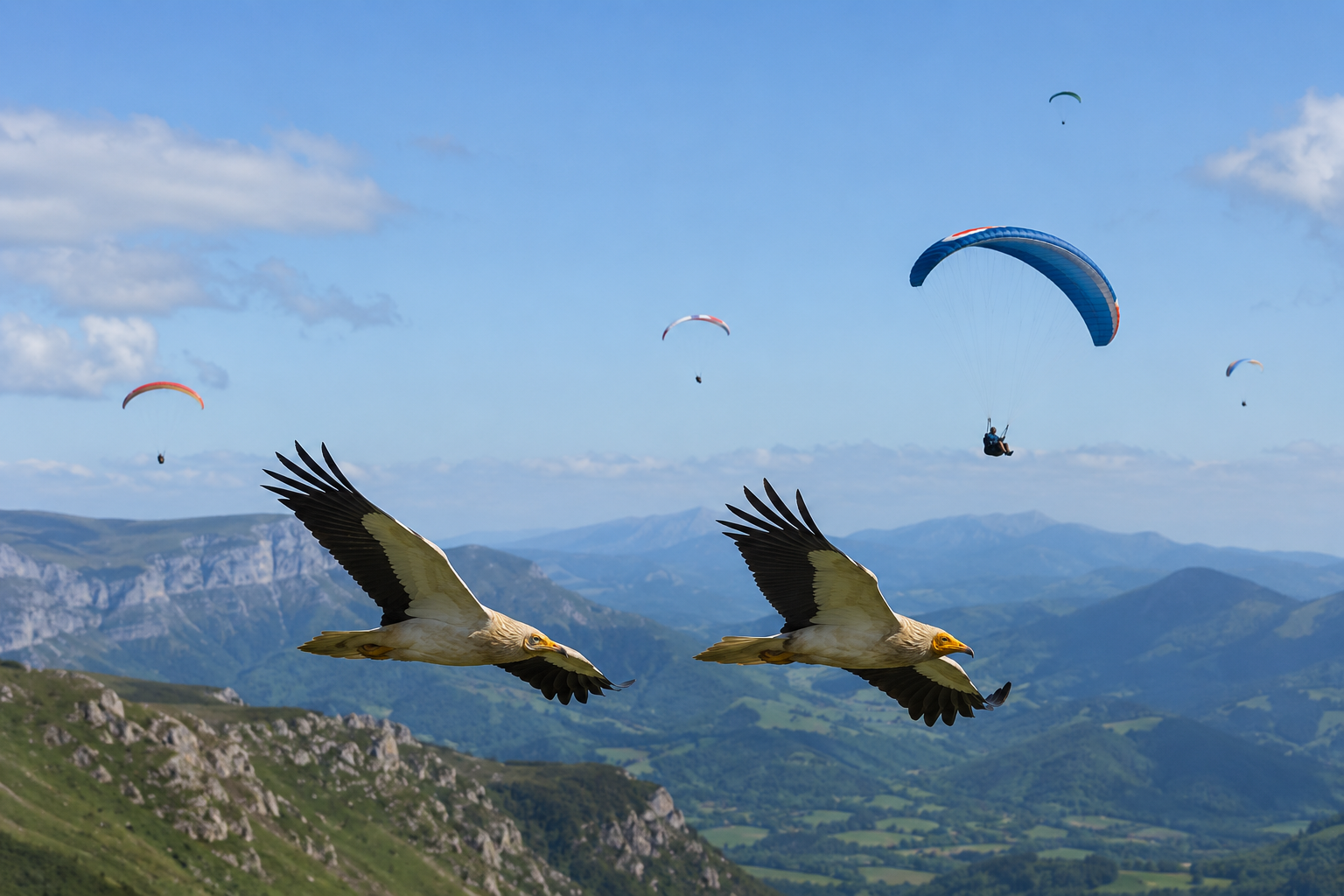
The community of pilots gathered around Ojovolador has publicly denounced the environmental organisation Ekologistak Martxan, accusing it of promoting campaigns based on speculation, unfairly criminalising the free-flight community and diverting attention from the real problems threatening the survival of the Egyptian vulture.
The complaint follows several publications in which Ekologistak Martxan links Egyptian vultures and paragliders to possible breeding failures of this emblematic scavenger. According to Ojovolador, these accusations lack sufficient scientific basis and help create a distorted image of both paragliding and those who practise this sport in direct contact with nature.
“We care deeply about the conservation of the Egyptian vulture, precisely because we love and live nature from the inside. That is why we find it irresponsible to point the finger at an entire community without conclusive evidence and based solely on hypotheses,” says the statement released by the community.
Wasted grants, subsidies and donations
The Ojovolador community maintains that for years significant amounts of public and private money have gone into campaigns, studies and conservation projects whose practical results are increasingly questionable.
According to the pilots, instead of focusing efforts on combating threats widely recognised by experts and authorities, certain organisations have chosen to look for easy media scapegoats that generate headlines and public visibility.
“Every resource invested in campaigns based on suspicion is a resource no longer spent on tackling the real problems affecting the species.”
The complainants consider it particularly serious that funds intended for conservation are used to push messages that, in their view, do not meet the minimum standards of scientific rigour required on environmental matters.
An accusation that does not fit the species’ biology
One of the central arguments of the complaint concerns the timeline of the events used to point the finger at paragliding.
The statement points out that the Egyptian vulture goes through its main courtship and egg-laying phases between March and April. However, some of the paraglider sightings used as evidence were recorded in June.
For the pilots, attributing a breeding failure to a flight observed after the laying season had already ended is reasoning incompatible with the basic biology of the species.
“If a pair has not bred during the season, the problem occurred much earlier. Linking it to a paraglider seen months later is not a scientific conclusion, just speculation.”
Hypotheses presented as facts
Ojovolador also criticises the repeated use of expressions such as “could have contributed”, “if the link is confirmed” or “possible disturbance”.
According to the complainants, this wording shows that there is no clear demonstration of causality between the flights observed and the birds’ breeding results.
“Hypotheses are a legitimate tool of science. What is not legitimate is turning them into accusatory headlines before they have been proven.”
The community believes that messages of this kind create a mistaken public perception and encourage the adoption of restrictive measures without the backing of solid evidence.
The real threats are left out of focus
The complaint points out that numerous studies and official reports have for years identified far more significant threats to the survival of the Egyptian vulture.
These include the illegal use of poisons, the decline of available food resources, collisions with power lines, the transformation of the rural environment and various accidents associated with human infrastructure.
For Ojovolador, it is striking that these widely documented threats receive less media attention than the occasional presence of a silent, non-motorised recreational activity practised by a small number of people.
An eco-friendly sport turned scapegoat
The pilots denounce the construction of a narrative that presents paragliding as an environmental threat without providing conclusive evidence.
They also point out that the vast majority of practitioners respect existing regulations, seasonal restrictions and areas sensitive for wildlife.
“The aim is to hold an entire community responsible for the mere sighting of a few isolated flights. That is not a conservation strategy; it is a strategy of finger-pointing.”
A call for rigour
The Ojovolador community concludes by asking that any decision related to the management of protected natural areas be based on independent studies, transparent methodologies and verifiable scientific evidence.
The pilots say they will continue to collaborate with any initiatives that seek to protect biodiversity through dialogue, knowledge and mutual respect.
“Conservation needs more science and less prejudice. The Egyptian vulture deserves real solutions, not campaigns built on suspicion.”
Sources:
https://es.wikipedia.org/wiki/Neophron_percnopterus
https://seo.org/ave/alimoche-comun/
https://scienceportal.tecnalia.com/en/publications/effect-of-human-activities-on-egyptian-vulture-breeding-success/