
We are rescuing the second most watched video in our archive: 194,000 views since 2011. A practical lesson on inflating with wind, filmed at Peña Negra on a day the conditions did not play along. Fifteen years later the core idea is intact, and below I tell you what I have learned since.
Peña Negra, August 2011
We were on an XC training course in Piedrahita and the conditions were not good: strong, somewhat gusty wind at the Peña Negra take-off. Instead of sitting it out, we ran a practical lesson right there. That is where this video came from. The line it closes with sums it up: it was not the ideal day, it was the one we had.
Inflating in wind: the wing does half the work
If you take one single thing from the whole video, it is this. The movement is pilot-wing, and it is clearest in terms of energy: the wing rises on its own, the wind inflates it and it gains energy. Your job is to walk towards it and take that energy away. One step or several, as many as it takes.
What people usually do is yank the risers. And in wind, the yank does the exact opposite of what you need: you amplify the energy and get catapulted. The alternative is far less spectacular and far more effective: regulate the inflation by walking towards the wing until you are under it.
Be the shock absorber
That is where you act as the shock absorber. The pressure stays constant and the body goes with it: if you stop dead, the wing drops, surges ahead and folds in front of you.
The more wind, the less arms
Here is the change of technique that is hardest to take on board. When inflating in strong wind you do not need to pull on the risers. You set yourself in position and work with a movement of the hips, not the back. One, two, three, and from there the correction is body only. The hands stop being the engine and become the fine adjustment.
When the wing goes to one side, the shoulder goes into the riser and loads that side. Body again, not arm.
The hands: where everything goes
To hold the wing on the ground in wind, the trick is to take both A risers of one side in a single hand. That gives you control of that whole side, and you carry the other one with the brake. A small brake input to stop it, and both hands back where they belong.
Bringing it down without a crumpled mess
The end is technique too. To bring the wing down in wind: brake it well, let it settle and take a step back so it lays out tidy. Otherwise it ends up crumpled and you pay for it when you pack. There is a classic technique for this that is somewhat asymmetric and that, personally, does not convince me.
Fifteen years later, in Kourion
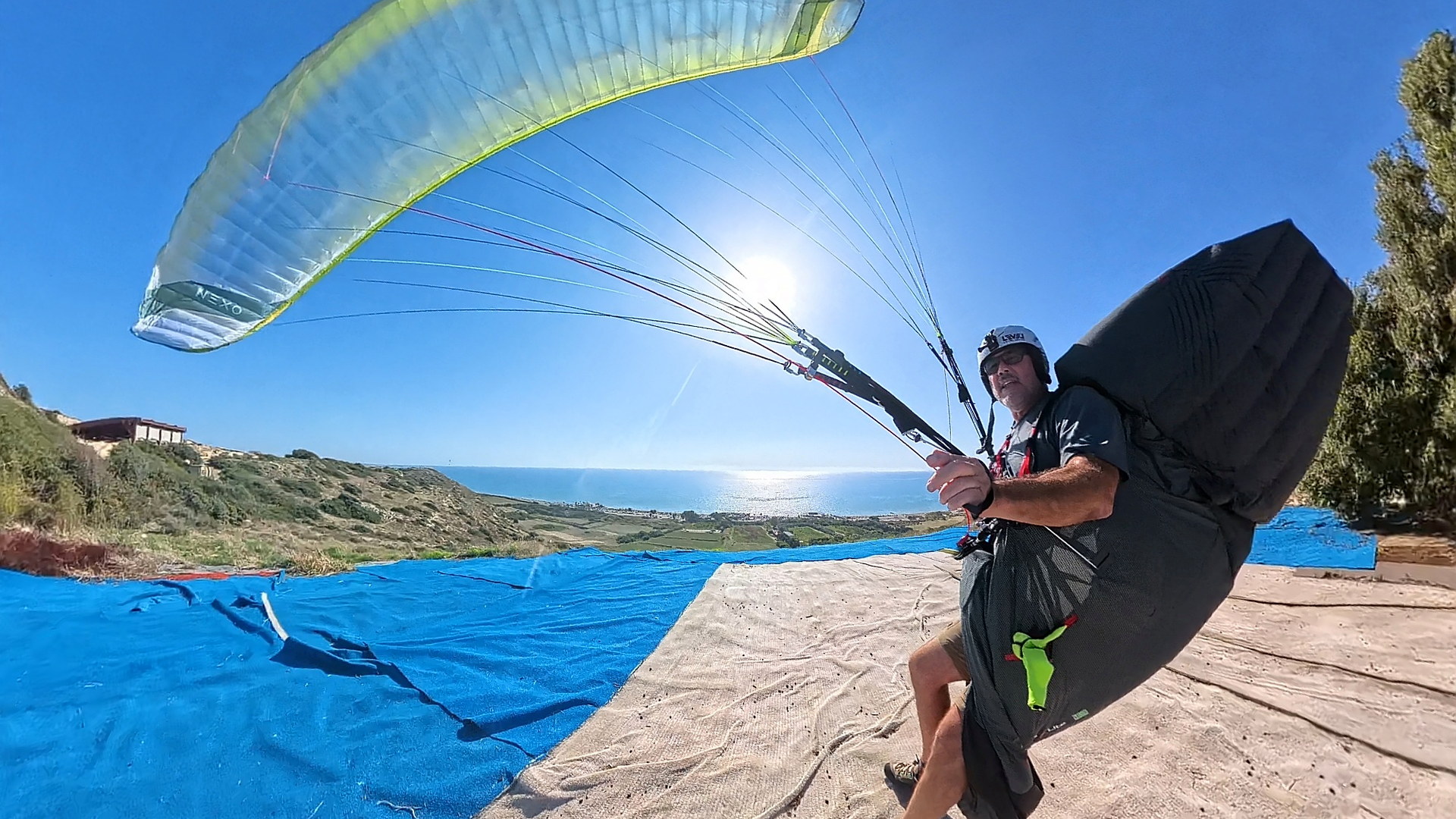
I fly in Cyprus now, and the Kourion take-off gets strong wind very often. This is the same technique from Peña Negra applied on a tandem, which is more demanding because you have someone in front of you.
What I have learned since: the cobra inflation
What I have definitely learned over these years is that the cobra inflation is the one that lets you deal best with wind. Sometimes, because of the layout of the take-off and the wind direction, it is awkward to pull off, but it is always worth reading the situation and looking for a way to do it.
That said, the conventional reverse launch, walking towards the wing, is a masterclass in energy management. If you get used to launching like that, you will be able to improvise inflations and launches anywhere and in almost any wind strength.
Let me explain. If you get to the take-off and there is a lot of wind, almost too much, it is better to go for the cobra. But sometimes, even launching in cobra, a gusty summer day can pull the wing out of it and load you all at once. That is when, if you have energy management down, you can solve almost any situation by improvising and moving around the slope.
Even launching in cobra, a gusty summer day can pull the wing out of it and load you all at once. That is where energy management gets you out of almost anything.
Daniel Crespo
My limit: where I stop
These days my limit is set by several things at once. The variables are, first, the wind speed; then how turbulent and gusty it is; the size and type of wing; and, very importantly, how big the take-off area is and what options you have if it goes wrong.
Inflating and launching at Peña Negra, in Piedrahita, with around 800 m² of matting and plenty of room behind you if you end up flying backwards, is not the same as doing it on a small take-off with a drop behind. In that second case the wind would put you in the rotor.
With those variables on the table, these are my numbers. Flying solo on a paraglider, 30 km/h, and up to 40 km/h if the wind is clean and the area lets me set the wing up in cobra. On a tandem I am much more conservative: 25 to 30 km/h is a reasonable limit, and if I feel there is the slightest risk, I do not try it.
With the parakite and mini wings the window widens a great deal, but there too you have to know how far you can push. My quiver runs from 23 down to 8 m², through 17 and 12, and with those sizes you can launch in more than 60 km/h. I have not done it yet, and I hope to soon.
And this matters: these are not fixed figures or a table that works for everyone. They are mine, today. This is a path of progression, and you will be able to widen that window yourself as you build skills and feel comfortable. That order, and not the other way round.
A recent example: the day I did not launch
Not long ago I got to the Kourion take-off with more than 50 km/h and I did not dare. Not because of a number, but because up there, in that wind, I was not comfortable. So rather than force it I went down to the coast to practise inflating in wind with the Level Wings Fuze.
Down there it was practically as strong, but I felt far more confident to practise and get the technique down before daring to do it at the take-off. That is exactly the difference I was talking about: the wind did not change, the ground did, and so did what happens if something goes wrong.
Why we are rescuing it
Because the video has not aged. The cobra has entered the equation and handles the hard days better, but it does not replace the other thing: it rests on it. What you learn inflating in wind, walking towards the wing, is exactly what saves you when the cobra goes wrong. Fifteen years on, the wing still does half the work. If you want to start at the beginning, here is the ground handling ladder with Raúl Rodríguez.
More videos to learn from
This video is one of the more than 600 on the Ojovolador YouTube channel, which has close to 16,000 subscribers. There is a lot of teaching material piled up there over the years: technique, tests, competition and flying.