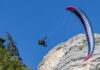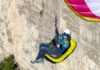
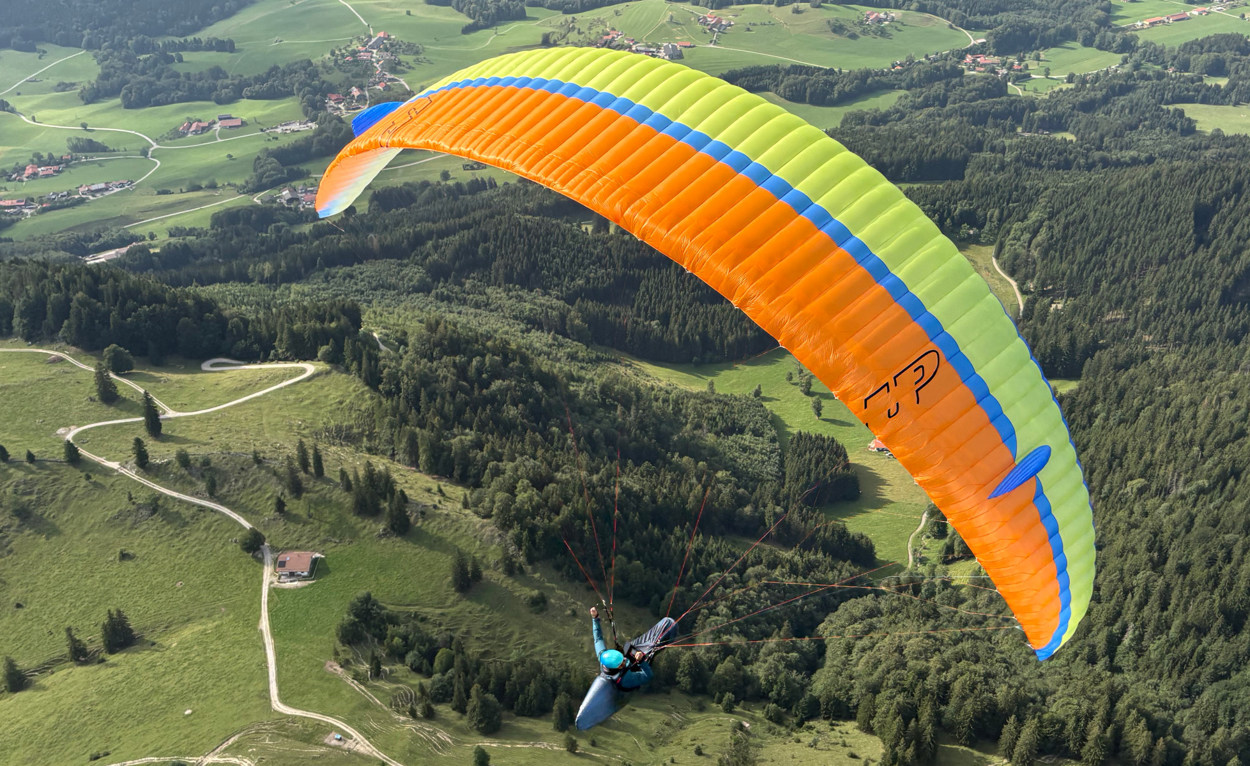
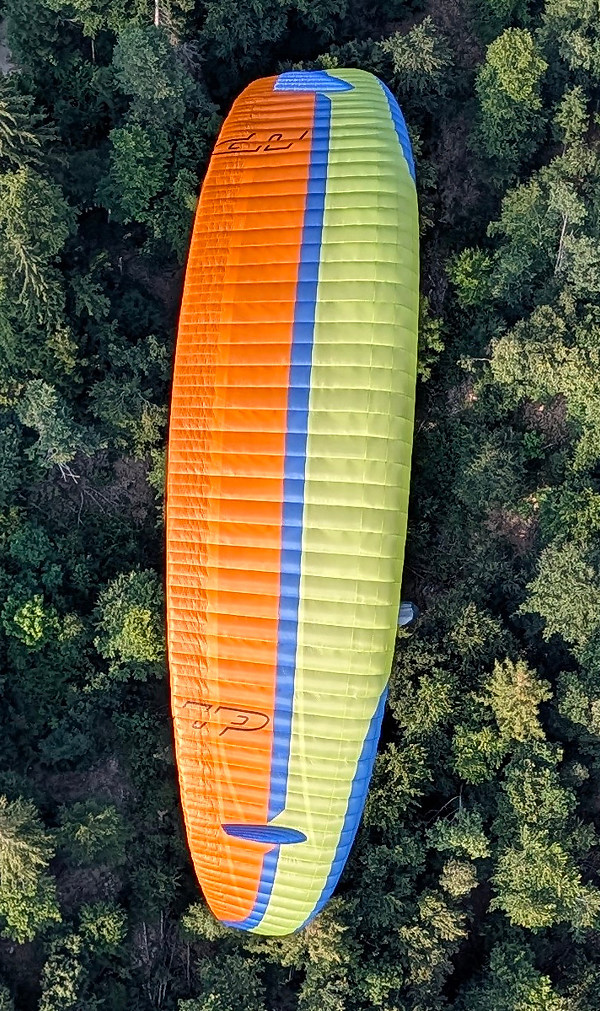
Among the new wings drawing the most attention at this year’s Coupe Icare was the UP Paragliders Cerro, the German brand’s new lightweight two-liner. We were able to see it and examine it at our leisure on the UP stand, risers in hand and canopy laid out, and the first conclusion is clear: this is not simply a Torre built from thinner cloth, but a wing with a personality of its own.
The UP Paragliders Cerro is presented as an EN-C* with certification still pending, and it will reach the market in spring 2027. Its goal is obvious: to bring the performance of a C-class two-liner to the world of hike & fly, where every gram on your back counts on that last steep climb before launch.
From Torre to UP Paragliders Cerro: what has changed
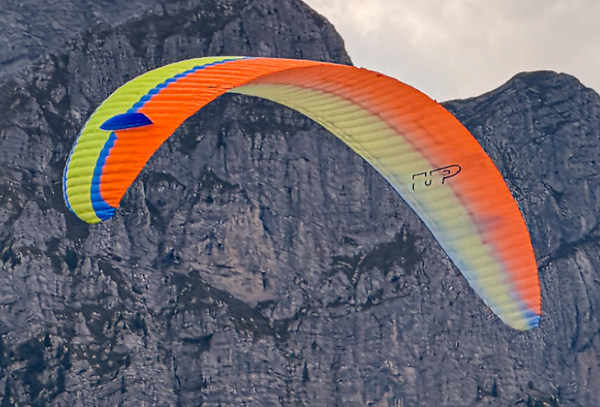
The UP Torre, UP’s first EN-C two-liner, has been one of the standout wings of the 2026 season. The Cerro inherits many of its solutions, but the designers have not stopped at changing the fabric. They have simplified the canopy’s architecture: the cell count drops from 67 to 63 and the projected aspect ratio goes from 6.45 to 6.10, with changes to the planform and to some elements of the internal structure as well.
The result on the scales is striking: 1,250 grams less than the Torre in size M. Size S comes in at 3.5 kg and size L at 4.1 kg. The brand has also revised the weight ranges, which now reach a maximum take-off weight of 120 kg in the largest size.
The crescent-shaped planform that pilots liked so much on the Torre, for tightening turns inside the thermal, is retained, and with it the winglets, which UP only adds when they bring something real to the package. The Cerro is the second model from the brand to feature them, and according to the manufacturer they help it recover from a spin with greater directional stability.
Fabric: Skytex 27 across the whole canopy
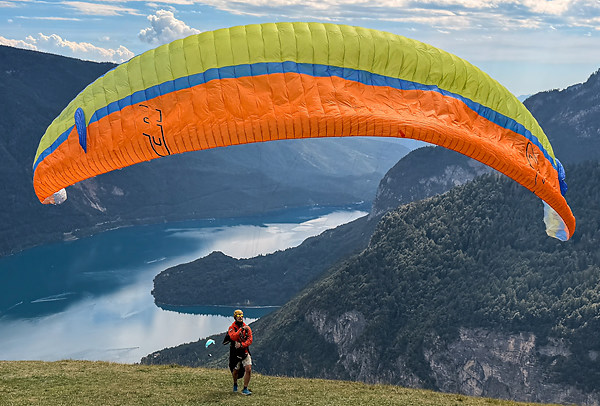
As soon as you touch the canopy, the difference from the Torre is obvious. The entire top and bottom surfaces are made of Porcher Skytex 27 Classic II, while the ribs combine Skytex 40 Hard and Skytex 27 Hard depending on the load zone. It is a sensible choice: a light cloth with a good reputation for durability, which is welcome on a wing designed to be packed and unpacked on rough mountain launches.
According to UP, this lighter fabric makes the Cerro inflate faster and with less effort than the Torre, which asks a little more input from the pilot at launch. The lines, from Liros DC and Edelrid 8001, are unsheathed but colour-coded, which makes pre-flight checks much easier.
The risers: the detail we liked most
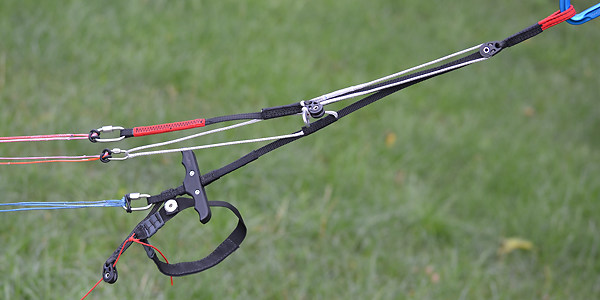
The risers are new and deserve attention of their own. They are made from 7 mm aramid webbing, with a system of micro-pulleys on ball bearings that saves weight without losing smoothness on the speed bar. They also feature adjustable handles for rear-riser control, which can be set to suit each pilot’s size and build. On a two-liner, where much of accelerated flight is managed precisely from there, the ergonomics of that grip are no minor detail.
UP points out two important things: B-stalls cannot be used as a descent technique on the Cerro, and big ears are done with the AR3 or BR3 techniques.
The pilot as the third riser
This, in our view, is the most interesting thing about the Cerro. On a three-liner, the wing handles a good part of the turbulence on its own. On a two-liner, part of that work moves into the pilot’s hands, as they control the angle of attack from the rear risers. In other words: the pilot becomes the third riser.
And this is where a curious paradox appears. Normally, the light version of a wing is the more specialised one, reserved for experts willing to sacrifice comfort. With the Cerro it works the other way round: by lowering the aspect ratio and the cell count, UP has created a wing that is more accessible than its heavier sister. The Cerro may well end up being the real gateway for many high-B pilots into the world of two-liners, not just an option for mountaineers. The barrier to entry is no longer in the rucksack, but in the hands: the manufacturer itself insists that only pilots who master rear-riser control will get the most out of it.
Who is the UP Paragliders Cerro for?
UP aims it at hike & fly and cross-country pilots looking for C-class performance, at those stepping up from a B+ with good technique, and at pilots with two-liner experience who want a more moderate aspect ratio. It is also for those who dream of vol-biv adventures, where the combination of low weight, stability and clear handling makes perfect sense. Pilots still progressing through the B class may find a better match in the UP Makalu 5, while those curious about the brand’s light range can read our review of the UP Lhotse X.
We hope to fly the UP Paragliders Cerro very soon, making the most of the autumn thermals, to tell you whether it delivers in the air what it promises on the stand.